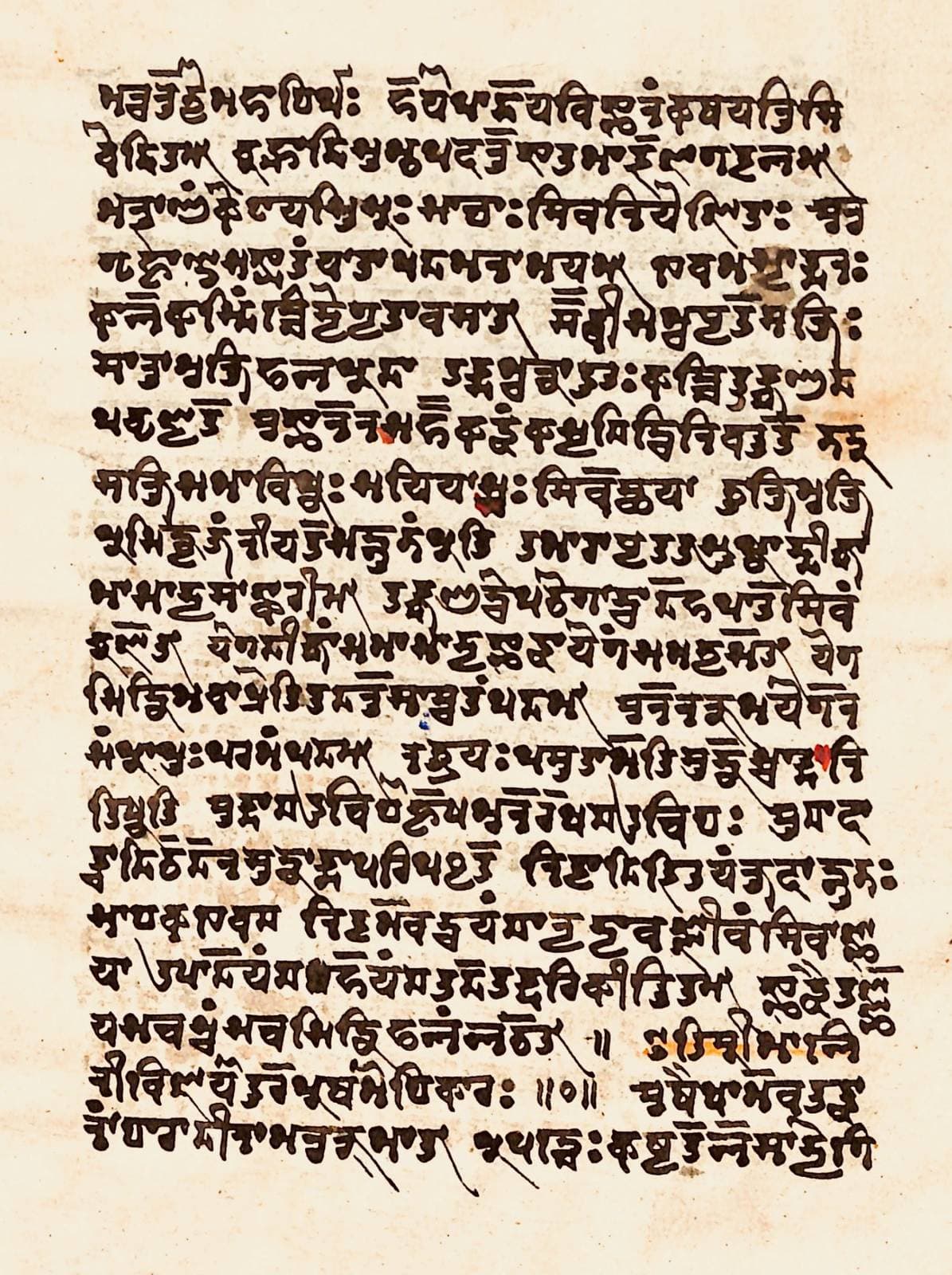
Kashmiri today is written mainly in a modified Perso-Arabic script, which the Jammu and Kashmir government recognises as its official script. Before that, it was written in Sharada, an Indic script now used mostly for religious purposes, and since 1990 some Kashmiri Pandits have written it in Devanagari. Online, many people type it informally in the Roman alphabet.
Each of these scripts has its own history, and each now comes with different levels of Unicode support, fonts and digital text. That last part decides how well software, search engines and AI models can handle Kashmiri, so this post covers both.
Sharada: the older script of Kashmir
Sharada descends from the Gupta script, itself a descendant of Brahmi. According to the Wikipedia summary of the scholarship, it was widespread in the north-west of the subcontinent between the 8th and 12th centuries, and it is named after the goddess Śāradā, another name for Saraswati, the goddess of learning. The Bakhshali manuscript, an early mathematical text, uses an early form of it.
In Kashmir, Sharada was used above all for Sanskrit. Kalhana's Rajatarangini, the 12th-century Sanskrit chronicle of Kashmir's kings, survives in Sharada manuscripts. Kashmiri itself was written in Sharada far less often: as Vinodh Rajan notes in a 2023 Unicode proposal, works in the Kashmiri language in Sharada are “particularly rare”, most likely because Sanskrit was the region's main scholarly and liturgical language. Because of this, Sharada never developed a standard set of letters for Kashmiri's many vowels. Scribes added a few diacritics instead. George Grierson described them in the Linguistic Survey of India (1919), as summarised in Anshuman Pandey's 2012 proposal to encode them.
The script declined from the 19th century, as Kashmiri came to be written more and more in a Persian script. The Endangered Alphabets Project describes how, by the end of the 20th century, Sharada was kept up mainly by Kashmiri Pandits for religious and ceremonial use. More recently there has been some revival: Rajan's proposal reports free classes, at least two regular publications that use Sharada for Kashmiri, and two primers for learning Kashmiri in the script.
The shift to Perso-Arabic
After Islam spread widely in Kashmir, a modified Perso-Arabic script was adopted for Kashmiri, and the Kashmiri language article dates the growing use of the Persian script for Kashmiri to the 19th century. The Kashmiri version is not simply Urdu's alphabet. Kashmiri has 17 vowels, shown with diacritics, letters (alif, waw, ye), or both, so the script adds vowel letters such as ٲ and ۄ. By convention most vowel diacritics are written all the time, which is unusual among Perso-Arabic scripts. It is usually set in the Nastaliq style and read right to left, as in the language's own name, کٲشُر (Koshur).
The official script today
Three separate things are often mixed up here:
- The Eighth Schedule. Kashmiri was one of the 14 languages in the original Eighth Schedule of the Constitution of India in 1950. The schedule now lists 22 languages.
- Official language of Jammu and Kashmir. The Jammu and Kashmir Official Languages Act, 2020 (No. 23 of 2020, assented to on 26 September 2020) made Kashmiri, Dogri, Urdu, Hindi and English the official languages of the Union territory. The Act names languages, not scripts.
- Official script. The Perso-Arabic script is recognised as the official script of Kashmiri by the Jammu and Kashmir government and the Jammu and Kashmir Academy of Art, Culture and Languages.
So, to the question “what script is Kashmiri written in?”, the short answer is Perso-Arabic. Devanagari and Sharada are used too, by smaller groups and for particular purposes.
Devanagari for Kashmiri
Devanagari has been used informally by some Kashmiri Pandits, especially since the community's displacement from the Valley in 1990. Standard Hindi Devanagari has no letters for several Kashmiri vowels, so new signs were needed. Rajan's proposal describes recommendations from the Indian government in 2002, which added eight characters (four vowels and their vowel signs), and a 2009 revision with six (three vowels and their signs). Some Kashmiri organisations use a further modified version of the 2009 scheme. Published Devanagari Kashmiri can follow any of these conventions, so the same word may be spelt differently in different sources.
Unlike Sharada, the Kashmiri-specific Devanagari characters were already in Unicode before the Sharada additions were proposed. For example, U+0975 DEVANAGARI LETTER AW was added in Unicode 6.0 (2010).
Roman script and informal Kashmiri online
Roman script is also sometimes used informally to write Kashmiri, especially online: in messages, comments and social media posts. There is no single agreed spelling, so the same word can appear in many forms. For language technology this text is real and current, but it is hard to collect, hard to tell apart from other languages written in Latin letters, and hard to normalise. Our own corpus filter keeps only rows where more than 20% of the characters on the Kashmiri side are Perso-Arabic, which drops Latin-script rows on purpose (see the dataset page).
What each script means for language technology
Sharada's main block, U+11180 to U+111DF, was added in Unicode 6.1 in January 2012. The three Kashmiri signs from Pandey's 2012 proposal, including U+111CA SHARADA SIGN NUKTA, followed in Unicode 8.0 (2015). In September 2025, Unicode 17.0 added a Sharada Supplement block (U+11B60 to U+11B7F) with eight Kashmiri vowel signs, each mapped to an existing Devanagari Kashmiri vowel sign. That means modern Kashmiri in Sharada could be fully encoded only from 2025. Fonts, keyboards and operating systems usually take time to support newly encoded characters, so check them before relying on them.
| Script | Unicode support | Fonts | Digital text (qualitative) | Typical uses |
|---|---|---|---|---|
| Perso-Arabic | Arabic blocks; Kashmiri letters such as U+0672 encoded since Unicode 1.1 | Nastaliq and Naskh fonts; test Kashmiri vowel letters before use | By far the most: news, books, government text, parallel corpora | Official use, publishing, education, most writing |
| Devanagari | Kashmiri vowel letters and signs encoded, e.g. U+0975 in Unicode 6.0 (2010) | Widely available Devanagari fonts | Much less; several competing spelling conventions | Some Kashmiri Pandit writing and publications |
| Sharada | Main block in 6.1 (2012); Kashmiri signs in 8.0 (2015); vowel signs in 17.0 (2025) | Few, e.g. Noto Sans Sharada; check coverage of 2025 additions | Very little machine-readable text; mostly manuscripts and images | Religious use, revival classes, manuscripts |
| Roman | Basic Latin; no Kashmiri-specific characters needed | Any | Plenty in chats and social media, but unstandardised and hard to collect | Informal messages online |
A few practical points follow from this.
- Benchmarks already treat script as part of the language. FLORES-200 lists
kas_Arabandkas_Devaas separate entries, and IndicTrans2 supports both. A score reported for “Kashmiri” means little until you know which script it was measured on. - Perso-Arabic Kashmiri overlaps with Urdu. The scripts share most letters, so language identification and translation models can confuse them, or produce Urdu-like output. The Kashmiri-specific vowel letters and diacritics are what tell them apart, so keep them during cleaning. We discuss this further in our post on low-resource NLP.
- Much printed Kashmiri is locked in legacy files. InPage, a page-layout program used for Urdu, Kashmiri and other languages, became Unicode-based only with version 3 in 2008, so older documents need conversion before they are usable as text. Our digitisation plans cover this and manuscript transcription; those tools are not built yet.
- Sharada text has to be created before it can be used. With so little machine-readable Sharada, the realistic routes are transcription of manuscripts and transliteration from Devanagari, which the one-to-one mapping in the 2025 additions makes simpler.
Basic facts about the language, and the figures behind our own work, are collected on our facts page.
Sources
- Kashmiri language and Kashmiri alphabet, Wikipedia
- Sharada script, Wikipedia
- Anshuman Pandey, Proposal to Encode Signs for Writing Kashmiri in Sharada, L2/12-124R, 29 August 2012
- Vinodh Rajan, Proposal to Encode Kashmiri Sharada Characters in Unicode, L2/23-122, 5 May 2023
- Unicode Consortium, Sharada Supplement code chart, Unicode 17.0
- U+11180, U+111CA and U+0975, Codepoints.net
- Sharada, Endangered Alphabets Project
- The Jammu and Kashmir Official Languages Act, 2020, Gazette of India, 27 September 2020 (via PRS India)
- Eighth Schedule to the Constitution of India, Wikipedia
- FLORES-200 language list and IndicTrans2, GitHub